
Bacteriostatic Water: What It Is and Why Used in Injections
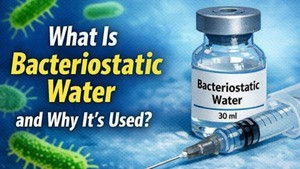
Bacteriostatic water is sterile water that includes a preservative to help slow bacterial growth after the vial has been opened. It’s commonly used when a medication needs to be diluted or reconstituted and the vial may be accessed more than once.
What bacteriostatic water is (in plain terms)
Bacteriostatic water is water for injection that contains a small amount of a preservative (most often benzyl alcohol). The goal is not to “sterilize” anything after the fact, but to reduce the chance that bacteria multiply if the vial is punctured multiple times.
It’s important to understand the limits: “bacteriostatic” means it inhibits bacterial growth, not that it kills all germs or makes non-sterile technique safe.
Bacteriostatic water vs sterile water: what’s the difference?
People often compare bacteriostatic water with sterile water for injection because they look similar, but they’re not always interchangeable.
- - Bacteriostatic water: includes a preservative, often chosen for multi-dose use.
- - Sterile water for injection: typically has no preservative, often intended for single-dose use (or as specified on the label).
- - Use case: the “right” option depends on what the medication manufacturer and your clinician recommend.
Why bacteriostatic water is used
Bacteriostatic water is used mainly for convenience and safety in situations where a vial may be entered multiple times.
- - Multi-dose access: the preservative helps reduce bacterial growth risk between uses.
- - Reconstitution: some medications supplied as powders need a diluent before use.
- - Reduced waste: multi-dose use can mean fewer discarded vials compared to single-use only.
Common situations where it may be used
Depending on the product instructions, bacteriostatic water may be used to reconstitute certain injectable medications (for example, some peptide-style products). Always follow the specific product guidance and professional advice.
If you’re browsing injectable product types, you may see this topic discussed alongside items such as HCG 5000IU, Tirzepatide 5mg, or BPC-157.
Safety notes that matter
Because bacteriostatic water is used with injections, small mistakes can matter. Keep these basics in mind:
- - Follow the label: not every medication is compatible with benzyl alcohol.
- - Do not share vials: multi-dose does not mean multi-person.
- - Use aseptic technique: the preservative is not a substitute for cleanliness.
- - Storage and discard: many multi-dose vials are commonly discarded within about 28 days after first puncture unless the product label says otherwise.
If you are unsure about compatibility, storage, or how to prepare a medication, speak with a pharmacist or clinician.
FAQ
Is bacteriostatic water the same as saline?
No. Saline is a salt solution (usually 0.9% sodium chloride). Bacteriostatic water is water with a preservative and no added salt.
Can bacteriostatic water be used for any injectable medication?
Not always. Some medications are sensitive to preservatives like benzyl alcohol. Always follow the manufacturer’s instructions and professional guidance.
Why not just use sterile water every time?
Sterile water is often preservative-free, which can be appropriate for single-use situations. Bacteriostatic water is often chosen when repeated vial access is expected.
Does “bacteriostatic” mean it’s completely safe from contamination?
No. It can help slow bacterial growth, but contamination can still happen. Clean technique and proper storage are still essential.
How should an opened vial typically be handled?
Use it only as directed, keep it stored according to the label, and discard it based on the product guidance (often within a set timeframe after first use).
Comments
No comment at this time!
Leave your comment